Re-Presenting Feminist Methodologies by Kalpana Kannabiran Padmini Swaminathan
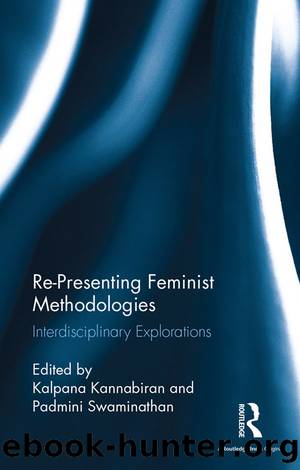
Author:Kalpana Kannabiran, Padmini Swaminathan [Kalpana Kannabiran, Padmini Swaminathan]
Language: eng
Format: epub
ISBN: 9781138633797
Barnesnoble:
Goodreads: 32913194
Publisher: Taylor & Francis
Published: 2017-03-15T00:00:00+00:00
Notes
1This chapter was published in the Economic and Political Weekly, Review of Womenâs Studies, vol. 51, no. 18, 30 April 2016, pp. 64â71. We are grateful to the editor, EPW, for permission to republish this chapter in this volume.
2Foucault talks about literature as a language of transgression, which is also a simulacrum of the book, directing aggression against the âfeminine essence of the bookâ â âLiterature is transgression, literature is virility of the language compared to the femininity of the bookâ¦. What can literature be, precisely, other than the frail, posthumous existence of language?â â in lectures on âLiterature and Languageâ at Brussels in December 1964 (Foucault 2015: 64â65).
3The University Grants Commission in January 2013 instructed Indian science and technology institutes to offer humanities courses to its students in order to âstop radicalization of youthâ of the country, defusing any subversive power of the humanities by relegating it to a moral âsoulâ-training exercise (reported extensively in Firstpost, dated 1 March 2013, and other newspapers and websites). While acknowledging that in contemporary political speech, âradicalizationâ has come to mean only the nurturing of potential terrorists rather than the uncompromising pursuit of social and economic reforms, one can yet deconstruct this myth of morality around the humanities, challenging the propositions that they are either containable by regulation or useful for containing the boldness of youth.
4Kumkum Sangari in her study of the relation between sex selection and commercial surrogacy in India uses solid and liquid as signifiers:
It can also sketch the volatile relations between the family, market and state, and describe the cords that bind migrant with embedded labour, the national with the transnational, the social with the postsocial body. The solid may not always be old, the old may be becoming liquid â patriarchal family forms can be liquescent, while the state and market can act as either solvents or hardeners of patriarchal practices.
(2015: 3)
Download
This site does not store any files on its server. We only index and link to content provided by other sites. Please contact the content providers to delete copyright contents if any and email us, we'll remove relevant links or contents immediately.
| Anthropology | Archaeology |
| Philosophy | Politics & Government |
| Social Sciences | Sociology |
| Women's Studies |
Cecilia; Or, Memoirs of an Heiress — Volume 1 by Fanny Burney(32533)
Cecilia; Or, Memoirs of an Heiress — Volume 2 by Fanny Burney(31931)
Cecilia; Or, Memoirs of an Heiress — Volume 3 by Fanny Burney(31922)
The Great Music City by Andrea Baker(31905)
We're Going to Need More Wine by Gabrielle Union(19025)
All the Missing Girls by Megan Miranda(15901)
Pimp by Iceberg Slim(14470)
Bombshells: Glamour Girls of a Lifetime by Sullivan Steve(14041)
For the Love of Europe by Rick Steves(13836)
Talking to Strangers by Malcolm Gladwell(13335)
Norse Mythology by Gaiman Neil(13324)
Fifty Shades Freed by E L James(13222)
Mindhunter: Inside the FBI's Elite Serial Crime Unit by John E. Douglas & Mark Olshaker(9305)
Crazy Rich Asians by Kevin Kwan(9264)
The Lost Art of Listening by Michael P. Nichols(7483)
Enlightenment Now: The Case for Reason, Science, Humanism, and Progress by Steven Pinker(7300)
The Four Agreements by Don Miguel Ruiz(6733)
Bad Blood by John Carreyrou(6604)
Weapons of Math Destruction by Cathy O'Neil(6252)
